
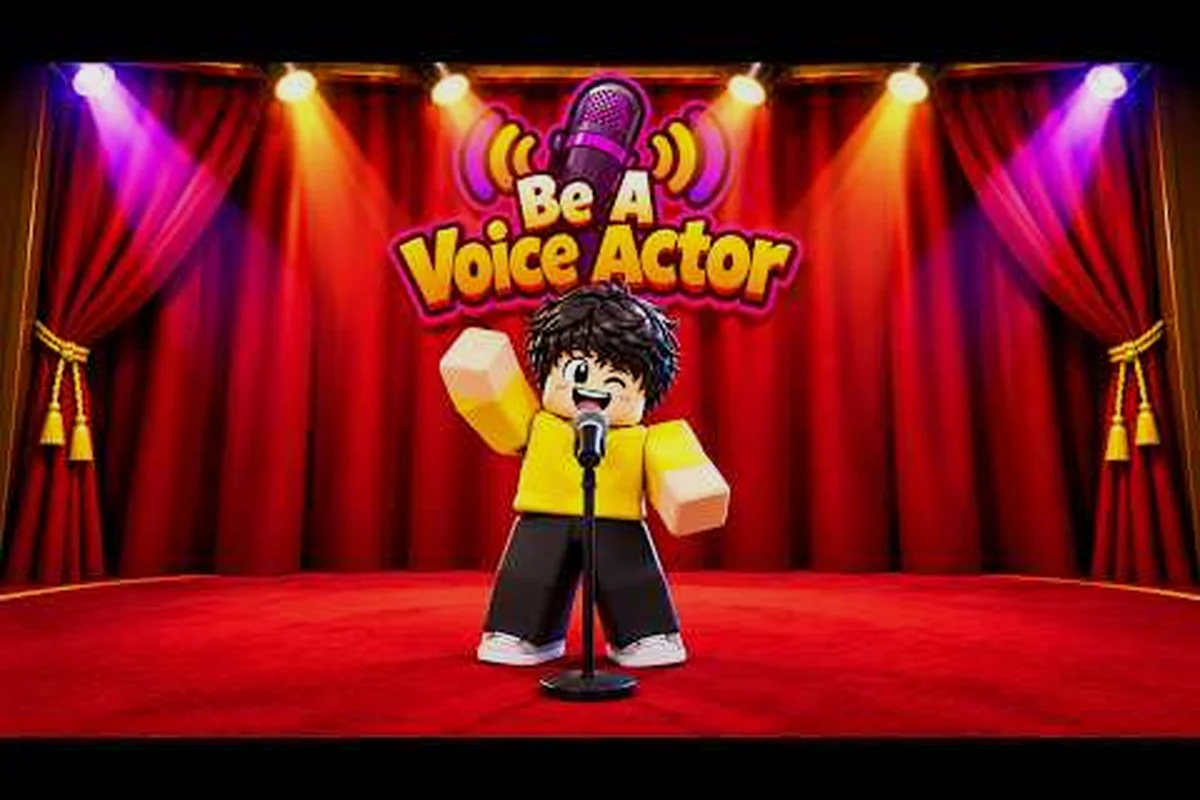
Be A Voice Actor has crossed 1.5 million visits in under three weeks, but players are now asking a sharper question: are be a voice actor exploits or downtime actually hurting the experience? This status check breaks down what the live data shows, how scoring works, and whether the Social party game is still growing or starting to stall.
Be A Voice Actor Exploits: What the Data Actually Shows
The most direct way to assess whether be a voice actor exploits are a real problem is to look at what the game actually tracks and exposes. Unlike competitive shooters or tycoon games, Be A Voice Actor does not maintain a public global leaderboard, a server browser with per-player score history, or any third-party stats site. According to the official Be A Voice Actor game page, scores are per-session: a lobby of up to seven players sees its own scoreboard, and the game saves your own progress, Gems, and scores automatically between sessions, but nothing is exposed globally.
This architecture matters because it changes what an "exploit" even means. In games with global leaderboards, exploits typically involve score inflation, duplicating currency, or manipulating rank. In Be A Voice Actor, the closest public proxies for skill are the the Ace badge count (133,226 awards as of 2026-09-18) and the Win A Round badge, but neither badge can be read off a leaderboard. The in-experience ranking surfaces on Roblox cover live player counts, not player skill. So when players ask whether be a voice actor exploits are damaging the game, the honest answer is that there is no public evidence of a score-manipulation epidemic, because there is no public score infrastructure to manipulate.
That does not mean exploits are impossible. The game requires Voice Chat verification to compete in scoring rounds, which filters out a large class of silent bots. However, the developer has not published any written patch notes or changelog — the only public version signal is the bracketed tag on the Roblox listing, which read [UPD 2] on 2026-09-18. Without written patch notes, any claim about a specific exploit being fixed or introduced has to be reconstructed from the listing tag, the last-updated timestamp, and community reports. Players who want to understand the core scoring loop before worrying about exploits should review the beginner guide to Be A Voice Actor, which explains how rounds are structured and where points come from.
| Exploit Concern | Public Evidence (as of 2026-09-18) | Risk Level |
|---|---|---|
| Score inflation via bots | No global leaderboard exists; Voice Chat verification required | Low |
| Gem duplication | No public reports; auto-save architecture | Low |
| Round manipulation | 7-player server cap limits lobby control | Low |
| Badge farming | Ace! badge at 133,226 awards, but no ranking impact | Medium |
| Silent lobby flooding | Voice Chat required to score | Low |
Be A Voice Actor Downtime: Tracking the Live Status
The second major concern is be a voice actor downtime — whether the game is frequently offline, crashing, or suffering from server instability. The live stats snapshot from 2026-09-18 shows 1,709 players in experience at the time of reading, which is a healthy concurrent count for a Social / Party genre game with a maximum server size of seven players. Total visits stood at 1,537,018, with 29,540 favourites and a 98.3% approval rating (14,698 likes against 260 dislikes). These numbers do not suggest a game that is struggling to stay online.
However, downtime is not always visible in aggregate stats. A game can have frequent short outages, lobby disconnects, or voice chat failures that never show up in the visit count. The developer account behind "Be A Voice Actor by Frameworks" ships all releases without a news page, devlog, or written changelog, so there is no official channel where players can check scheduled maintenance or known issues. The only public signals are the last-updated timestamp on the place (2026-09-18) and the created date (2026-08-30). When the game updates, the listing tag changes — currently [UPD 2] — but players have no way to know what changed or whether the update introduced new downtime risks.
Community reports suggest that downtime in Be A Voice Actor is typically tied to voice chat verification failures rather than full server outages. Because Voice Chat is required to compete, any player who has not completed platform voice verification cannot take part in a scoring round. This creates a different kind of "downtime" — a player can be in the lobby, see the round start, and still be locked out of scoring because their voice verification is pending or failed. That is a frustrating experience, but it is not a server exploit or a game-wide outage.
| Downtime Signal | Value (2026-09-18) | Interpretation |
|---|---|---|
| Players in experience | 1,709 | Healthy concurrent count |
| Total visits | 1,537,018 | Strong growth since 2026-08-30 |
| Favourites | 29,540 | High retention signal |
| Approval rating | 98.3% | Very positive player sentiment |
| Last updated | 2026-09-18 | Active development cadence |
| Version tag | [UPD 2] | Second content version shipped |
Be A Voice Actor Event and Visits: Growth Trajectory
The third angle is be a voice actor event activity and the broader visit trajectory. The game launched on 2026-08-30 and reached 1.5 million visits by 2026-09-18 — roughly 80,000 visits per day on average. That is a strong launch curve for a Roblox Social / Party game, especially one that requires voice chat, which historically limits the addressable audience. The closest competitor in the imitate-the-sound sub-genre is Make That Sound! (Roblox place 118987420842355), which launched 2026-08-31 with about 3.4 million visits and roughly 22,000 favourites. Make That Sound! has been live longer and therefore has a larger accumulated visit count, but Be A Voice Actor counters with a hard 7-player server cap, a shorter round rotation, and a faster update cadence.
The visit trajectory matters because it directly answers the question of whether be a voice actor is it dying. A game that is dying typically shows declining concurrent players, falling favourites, and a widening gap between visits and active players. Be A Voice Actor shows none of those signals as of 2026-09-18. The approval rating of 98.3% is exceptionally high for a Roblox game, and the favourite count of 29,540 represents roughly 1.9% of total visits — a healthy conversion rate that suggests players are returning and engaging, not just clicking once and leaving.
That said, the lack of a public event calendar or seasonal content pipeline is a real gap. The game's About text mentions "Special Gamepasses With Exclusive Perks" and asks players to join the group, like, and favourite, but there is no visible event schedule. Players who want to know whether a limited-time be a voice actor event is coming should check the limited event coverage, which tracks seasonal and time-limited content signals. Without a clear event cadence, the game relies entirely on its core loop — listen to a clip, copy it into your microphone, get scored — to drive retention.
| Growth Metric | Be A Voice Actor | Make That Sound! | Notes |
|---|---|---|---|
| Launch date | 2026-08-30 | 2026-08-31 | One day apart |
| Total visits | 1,537,018 | ~3,400,000 | Competitor has longer live time |
| Favourites | 29,540 | ~22,000 | Be A Voice Actor has higher fav rate |
| Server cap | 7 players | Not specified | Be A Voice Actor is tighter |
| Update cadence | [UPD 2] by 2026-09-18 | Not specified | Be A Voice Actor updates faster |
Be A Voice Actor Popularity: Why the Social Loop Works
Understanding be a voice actor popularity requires looking at what makes the game sticky. The core loop is deceptively simple: a lobby of up to seven players hears a sound clip, each player imitates it into their microphone, and the game scores the imitation. The About text frames it as "Compete To Become The Best Voice Actor!" and "Imitate Popular Sounds!" — a party-game premise that works because it turns voice chat from a communication tool into a competitive mechanic. That is a genuinely novel hook in the Roblox ecosystem, where most Social games use voice chat as an optional add-on rather than the core scoring input.
The 7-player server cap is a deliberate design choice that boosts popularity in two ways. First, it keeps rounds short and chaotic, which suits the party-game energy. Second, it creates a sense of intimacy — seven players in a lobby feels like a group of friends, not an anonymous crowd. This is the opposite of games that chase massive server counts, and it appears to be working: the 98.3% approval rating is among the highest in the Social / Party genre. Players who want to improve their imitation skills and climb the per-session scoreboard can find practical advice in the improvement guide for Be A Voice Actor, which covers warm-up exercises and microphone technique.
The popularity signal is also visible in the badge economy. The Ace! badge has been awarded 133,226 times as of 2026-09-18, which means a significant fraction of the 1.5 million visitors have actually engaged with the scoring system deeply enough to earn a badge. Badge counts are a lagging indicator — they accumulate over time — but they confirm that players are not just visiting; they are competing, winning rounds, and returning for more. That is the difference between a viral spike and sustained popularity.
Be A Voice Actor Is It Dying: A Reality Check
The question of whether be a voice actor is it dying deserves a direct, data-backed answer. As of 2026-09-18, the answer is no — the game is not dying. The evidence is clear: 1,709 concurrent players, 1,537,018 total visits, 29,540 favourites, a 98.3% approval rating, and an active update cadence with the [UPD 2] tag shipped on the same day as the data snapshot. A dying game does not push updates, maintain a near-perfect approval rating, or hold over 1,700 concurrent players three weeks after launch.
However, there are structural risks that could change this trajectory. The first is the single-developer bottleneck. All releases ship from one developer account behind "Be A Voice Actor by Frameworks," with no news page, no devlog, and no written changelog. If that developer slows down, burns out, or moves to another project, the game's update cadence — currently its strongest competitive advantage against Make That Sound! — could stall. The second risk is the voice chat dependency. Voice Chat verification is required to compete, which means the game's addressable audience is capped by how many Roblox players have completed platform voice verification. That is a hard ceiling that other Social games do not face.
The third risk is the lack of a public event pipeline. The game currently has no visible seasonal event calendar, no limited-time rewards track, and no announced content roadmap. For a game that relies on repeat play, the absence of events means the core loop has to carry all retention weight. If players exhaust the novelty of imitating sounds, there is no event hook to pull them back. The limited event tracker monitors whether the developer introduces seasonal content, which would be a strong signal that the game is investing in long-term retention rather than coasting on launch momentum.
| Death Signal | Present in Be A Voice Actor? | Evidence |
|---|---|---|
| Declining concurrent players | No | 1,709 players on 2026-09-18 |
| Falling approval rating | No | 98.3% approval, 14,698 likes |
| Stalled updates | No | [UPD 2] shipped 2026-09-18 |
| No new favourites | No | 29,540 favourites and growing |
| Developer silence | Partial | No written changelog, but active updates |
| Event pipeline gap | Yes | No visible seasonal event calendar |
How Competitive Scores Are Actually Tracked
The final piece of the puzzle is how competitive scores are tracked at all, because this is where most confusion about be a voice actor exploits originates. The game does not have a global leaderboard, which means "the best player" cannot be read off any ranking. Instead, the scoring system is entirely per-session: a lobby of up to seven players sees its own scoreboard during and after each round, and the game saves your own progress, Gems, and scores automatically between sessions. This means your personal best is tracked locally, but there is no public comparison against other players.
This design choice has real implications for competitive play. In a game with a global leaderboard, players can see exactly where they rank and what score they need to beat. In Be A Voice Actor, the competitive feedback loop is contained within each lobby — you know you won the round, but you have no idea how your score compares to players in other lobbies or on other days. The Ace! badge (133,226 awards) and the Win A Round badge are the only public signals of skill, and even those are binary achievements rather than ranked scores. Players who want to understand how to maximize their per-round score should review the beginner tips for Be A Voice Actor, which breaks down the scoring inputs and round strategy.
The absence of a global leaderboard also explains why be a voice actor exploits are hard to verify. Without a public score history, there is no way to detect anomalous score spikes, no way to compare a player's claimed score against a verified baseline, and no way to audit whether a score was earned legitimately. The game's architecture simply does not expose the data that would be needed to prove or disprove exploit claims. That is not a flaw — it is a deliberate design choice that prioritizes the party-game experience over competitive transparency. But it does mean that any claim about exploits in Be A Voice Actor should be treated as unverified unless the developer publishes written patch notes or a public leaderboard.
| Scoring Element | How It Works | Public Visibility |
|---|---|---|
| Per-session scoreboard | Lobby of up to 7 players sees own scores | Lobby only |
| Personal progress | Auto-saved between sessions | Player only |
| Gems | Auto-saved, used for gamepass perks | Player only |
| Ace! badge | Awarded for scoring achievement | Public count (133,226) |
| Win A Round badge | Awarded for round victory | Public count |
| Global leaderboard | Does not exist | None |
Frequently Asked Questions
Are there any confirmed be a voice actor exploits?
No confirmed exploits have been publicly documented as of 2026-09-18. The game has no global leaderboard to manipulate, requires Voice Chat verification to score, and ships updates without written patch notes, so exploit claims are difficult to verify. Community reports focus on voice verification failures rather than score manipulation.
How often does Be A Voice Actor experience downtime?
Full server outages are rare based on the live stats snapshot showing 1,709 concurrent players on 2026-09-18. The more common issue is voice chat verification downtime, where players are locked out of scoring rounds because their platform voice verification is pending or failed, which feels like downtime but is not a server outage.
Is Be A Voice Actor still popular in 2026?
Yes. The game reached 1,537,018 visits and 29,540 favourites by 2026-09-18, with a 98.3% approval rating from 14,698 likes. The [UPD 2] tag shipped on the same day confirms active development. These are strong popularity signals for a Social party game launched less than three weeks earlier.
Will Be A Voice Actor get seasonal events?
There is no public event calendar or seasonal content roadmap as of 2026-09-18. The developer has not announced any limited-time events, and the only version signal is the bracketed listing tag. The absence of a visible event pipeline is the biggest retention risk the game currently faces.
Can I see a global leaderboard in Be A Voice Actor?
No. The game has no public global leaderboard, no server browser with per-player score history, and no third-party stats site. Scores are per-session within a lobby of up to seven players, and only your own progress is saved between sessions. The closest public skill proxies are the Ace! and Win A Round badge counts.